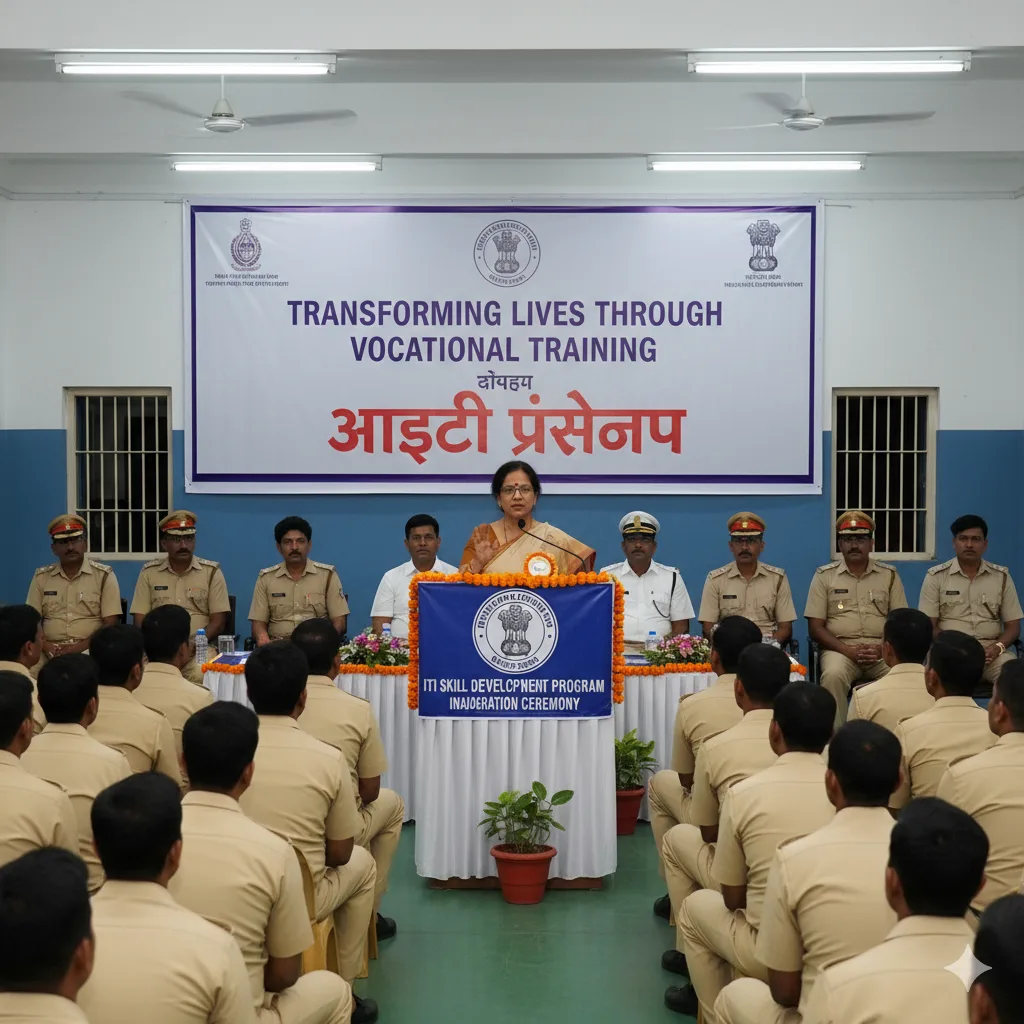
There are 7 million students enrolled in total, each year, in the Indian vocational training system. This is small compared to the number of new workers entering industrial sectors each year, which is double the number enrolled in vocational training, it is very small compared to the 39 million students enrolled in higher education, but above all it is a drop in the ocean when one considers the hundreds of millions of workers who have received no vocational training and whom the Indian government has set itself the goal of training. Alongside ad hoc programmes created according to industry needs and with the agreement of local authorities (Vocational Training Providers, Skill Development Center), there are approximately 16,000 main training centres, divided between 13,300 ITI (Industrial Training Institutes, intended to be equivalent to our CFA and accounting for 36% of total vocational training enrolments in India and offering training in 126 trades) and 2,200 Polytechnics/Engineering Colleges (comparable to IUT as they lead to two‑year diplomas and then to BTech) which account for the largest share of secondary and higher vocational training. The ITI system dates back to 1950 and its significant growth has led the body that governs it (the Directorate General of Training, DGT, under the supervision of MSDE) to consider introducing a ranking of ITIs, similar to the national ranking that exists for universities (the NIRF). To this system must be added that of open universities, a network that brings together millions of students and which has been committed to delivering vocational skills training for more than 10 years in India.
1/ Indian structures
Two competency frameworks were historically developed in parallel in India, partly due to the inability of Indian administrations to maintain consistent communication. Thus, the National Vocational Qualifications Framework (NVQF) of the Ministry of Labour was created at the same time as the National Vocational Education Qualifications Framework (NVEQF) of the Ministry of Human Resource Development (MHRD) in 2011. In 2013, recognising the deadlock, the Indian government decided to create an inter‑ministerial committee to develop a unified framework, the National Skills Qualifications Framework (NSQF), under the authority of a new body, the National Skills Development Agency (NSDA). Thus, following the initial impetus of 2009 (National Policy on Skill Development, 2009) and its subsequent replacement by the National Policy on Skill Development and Entrepreneurship in 2015, a profound movement emerged, aimed at producing effective articulation between vocational education and training (VET) systems and general education. The regulations established as early as 1956 by the NCVT (National Council for Vocational Training) were therefore entirely updated in 2018 under the authority of the National Council for Vocational Education and Training (NCVET), bringing under its remit the various Sector Skill Councils as well as the NSDA. All these bodies fall under a single ministry, the Ministry of Skill Development and Entrepreneurship, whose minister also oversees Education at the Union level, and therefore higher education as well. The objective of the NSQF was to provide a single framework for the assessment of competencies across all sectors and all technical levels of trades, but also at all levels of progression in general technical training: technical secondary education, technical education in higher education, and all formal and non‑formal training related to vocational education were to find their assessment framework within it.
2/ The rise of skills and the needs of the Indian economy