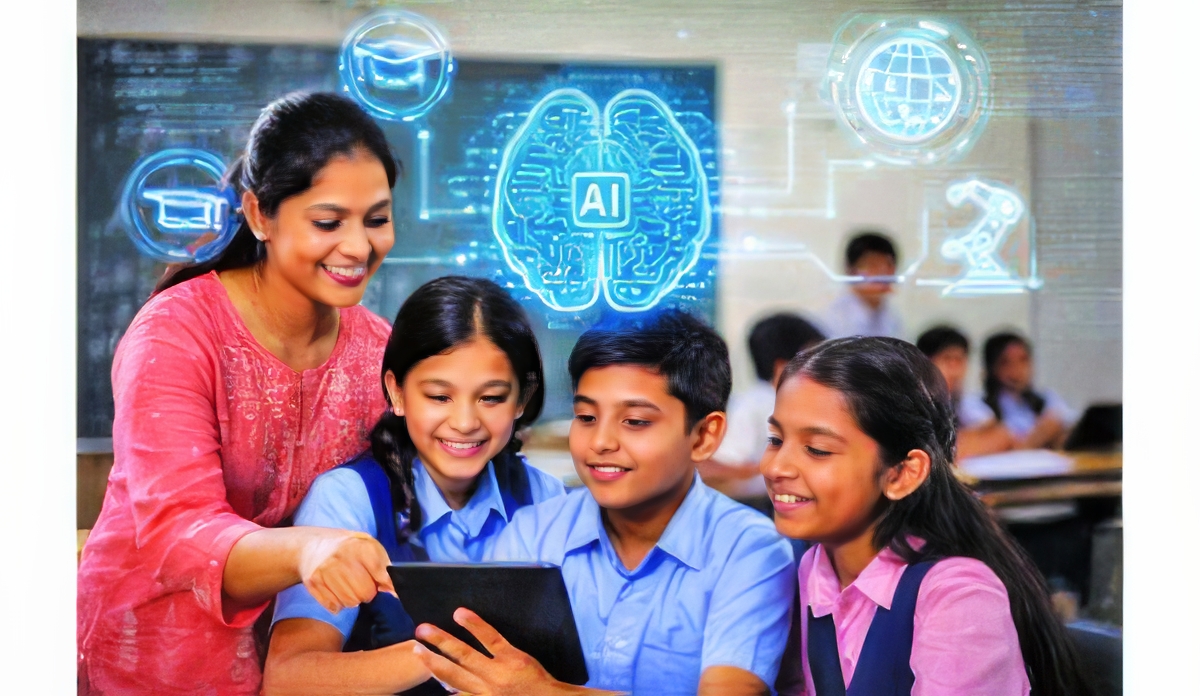
AI: What Indian Universities can learn from the West
Six years after the National Education Policy 2020 urged universities to break down the walls between subjects, artificial intelligence is becoming the tool for doing it. American and British universities moved earlier, and their experience offers lessons for Indian campuses still deciding how far and fast to go.
By The Pioneer, MD Afshar AlamOriginally published October 14, 2026ACNOctober 14, 2026 3 min read
Ohio State University has set the most ambitious target. From the class of 2029, every graduate is expected to be fluent in AI and its responsible use within their own discipline. Provost Ravi V Bellamkonda says students will become “bilingual”: fluent in their major and in applying AI within it. A course called “Unlocking Generative AI” is open to all majors, an AI skills seminar is compulsory, and at least six offices guide academic integrity. A history student uses AI for research, an agriculture student for crop data. Neither becomes a computer scientist. MIT built a new college instead. The Schwarzman College of Computing links computing with all five of MIT’s schools, and its Common Ground programme helps departments design classes blending computing with other fields. A standing committee of 29 faculty members reviews proposals. Common Ground awards no major or minor of its own: its subjects sit inside existing degrees, so AI becomes part of a physics or economics degree rather than a side certificate. A separate initiative, SERC, embeds ethics in computing courses.
Oxford chose tools, training and governance together. It was the first UK university to give all students and staff free ChatGPT Edu access, after a year‑long pilot with 750 staff members, and it created an AI Governance Group. Departments issue subject‑specific guidance. California State University went for scale, rolling out ChatGPT Edu to more than 460,000 students and 63,000 staff members across 23 campuses, comparable to an Indian state university network.
The Indian experience
The push began with regulators. AICTE declared 2025 the Year of Artificial Intelligence, covering more than 14,000 colleges, and promised faculty workshops and certifications.
IIT Madras offers the closest parallel to Ohio State. Its “AI for All” courses on SWAYAM Plus, including AI in Physics, AI in Chemistry, AI in Accounting and Cricket Analytics with AI, need no prior AI or programming experience. In January, it launched them in Hindi, free to access, a step no Western example here has matched.
IIT Hyderabad echoes MIT’s joint teaching: its 12-credit Minor in AI and Humanity has projects co‑supervised by liberal arts, design and engineering faculty members. IIT Mandi offers its 24-credit AI minor to other institutions. Oxford’s route has arrived too. In February, OpenAI announced ChatGPT Edu partnerships with IIT Delhi, IIM Ahmedabad, AIIMS New Delhi, Manipal, UPES and Pearl Academy, covering more than 100,000 people. Beyond the elite, the Central University of Haryana will introduce AI courses across all programmes from 2026-27, nearing Ohio State’s model.
(...)
The writer is the former Vice‑Chancellor of Jamia Hamdard; Views presented are personal.