Twenty‑four years ago, on September 11, 2002, Gen Pervez Musharraf signed the Higher Education Commission Ordinance that formally launched Pakistan’s ground‑breaking higher education reforms.
This legislation dissolved the University Grants Commission and, in its place, created the Higher Education Commission (HEC) with vast regulatory, financial and administrative autonomy, and an express mandate to restructure the national higher education system and set Pakistan on course to become a knowledge economy.
Over the next five years, the budget allocation for higher education went up by 5,000 percent. Billions were poured into setting up new universities. A landmark agreement was negotiated with the US to launch what was then considered the world’s largest Fulbright scholarship programme, worth $150 million. Some 5,000 PhD level scholarships were announced for foreign universities, the largest such programme undertaken by a developing country, as well as 3,000 indigenous scholarships. A tenure track system with very competitive salaries was launched to attract and retain the finest academics.
To term these plans ‘ambitious’ would be an understatement.
(...)
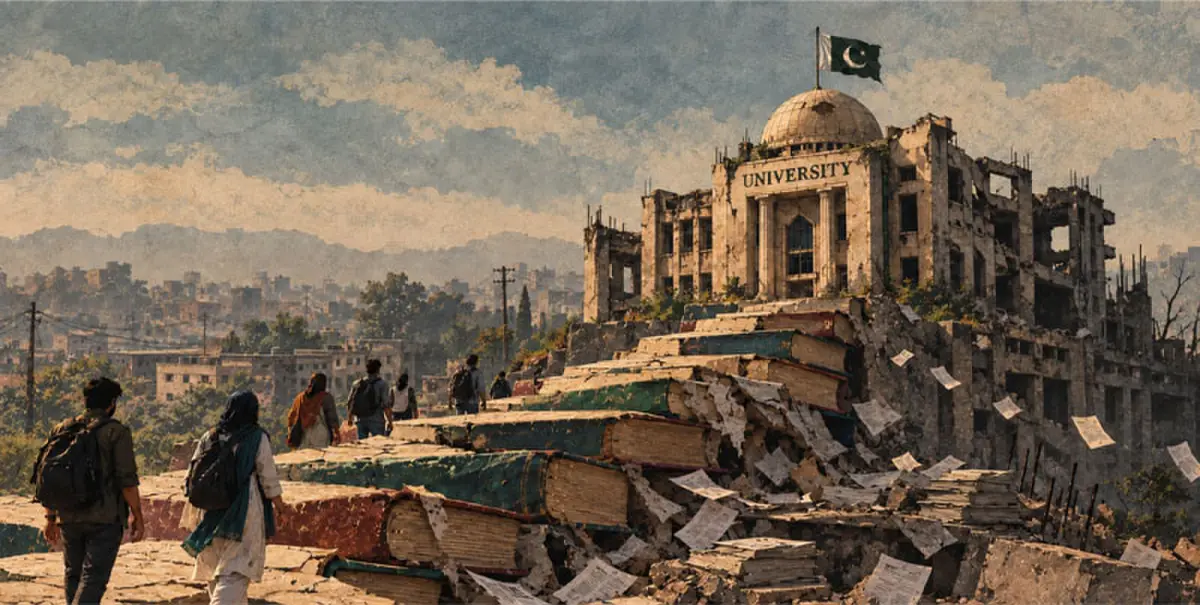
Launched in 2002 with unprecedented funding and ambitious reforms, Pakistan’s higher education experiment once attracted international attention. Today, Pakistan has nearly 280 universities, millions of students and a rapidly expanding research output. Yet, beneath the impressive statistics lies a system struggling with mounting debts, poor educational outcomes and questionable scholarship. What has gone wrong? And is there any way out?
(...)
Within a decade, the HEC’s autonomy was challenged and higher education funding was dramatically slashed. In an earlier piece, we tracked the collapse of Pakistan’s tenure track system and the mass exodus of Pakistan’s best and brightest academics. Now, as our higher education experiment enters its 25th year — its silver jubilee — it is time to ask the big questions: where do we stand today? What have we accomplished? What mistakes have we made? And, most importantly, how do we move ahead?
(...)
Our universities are also decades behind international best practices, featuring cumbersome processes and paperwork reminiscent of our colonial era and abysmal governance.
A Supreme Court order of 2024 noted that most universities are in contravention of their own laws and are being run on the “personal whims” of those in charge. Almost all public sector universities have too many non‑academic staff, significantly in excess of the HEC’s prescribed 1:1.5 ratio of academics versus non‑academics. A recent HEC survey found that a staggering 40 percent of key faculty and administrative positions in universities were lying vacant.
With numbers like these, one cannot help but wonder: how are things still even working?
(...)